





Scandal: Gambling: Brass Vases
This article pulls together information taken from 150 years of Church Committee Minutes. Our church is made up of people and their stories are the most important aspects of the life of our Meeting House. Please read on to find out more about them.
Story of the Church’s Name and some of it’s ministers
I will begin by telling you about the land the church is built upon. The Initial Trust Deed, dated the 17th June 1736 stated -
‘The true intent of this deed is that the premises and building be used and enjoyed as a meeting house for the public worship of God by the Congregation of Protestant Dissenters at Maidstone.’
The church was known throughout the 1800s as The Earl Street Chapel. But in 1895 a Special Meeting was held and it was decided to change the name to ‘The Maidstone Unitarian Christian Society assemblying for public worship at the Chapel, Earl Street’. Given the length of this it is no surprise that in 1907 the progressive minister, Rev Alexander Farquharson, changed the name again - to the one we use today, ‘Maidstone Unitarian Church’.
We have had many ministers since 1736. There seemed to be a spate of ministers in the late 1880s who would be hired for a set salary. Then, again and again, if the congregations did not increase and the income from collections and pew rents reduced then these ministers were told that the church could not afford to pay them. The minister would then resign and a new minister would be hired on the same pay grade but they were similarly encouraged to leave if the money coming in was not sufficient. One minister enraged the congregation in 1890. He became engaged to a junior member of the choir and was then sacked. Furthermore, on it being found that he was inebriated on several occasions at his lodgings he forfeited his three month notice period. Our most successful minister was the Rev Alexander Farquharson. He served here from 1905 until his death in 1924. He lived in London and never moved down to Maidstone. Under his stewardship the congregations bloomed to such an extent that the church became far too small for the 200 to 350 people who attended regularly, mornings and evenings, each Sunday. Around that time the Sunday School had 90 students and six teachers.
Story of the Hall and it’s users.
Rev Farquharson and the committee decided to buy land at Rocky Hill, over the river, and plans were drawn up to build a new, much bigger church. In 1907 the land was bought for £700. To raise funds a Grand Bazaar was held in May 1911. Nearly £200 was raised - an amazing sum given that the minister’s annual salary at that time was also £200. However, by 1917 the idea of a new church was abandoned. Land beside and behind the church was bought for £500 - which would be built upon to make a hall and schoolroom. The hall was finally built by 1934. The land on Rocky Hill was sold in 1929 for £700 (the same amount as it had been bought for 22 years earlier).
So who used this hall? The Sunday School finally had a place to go, socials and committee meetings were held there too. Various groups applied to use the space. In 1935 the National Unemployed Association was denied access. In 1938 the Co-Op Women’s Guild, The Refugee Committee and the Communist Party all used the hall. The ‘Old Contemptibles’ Wives Association’ wrote to the committee asking to use the hall for a party, they would be charged 25/- (25 shillings). But they were refused the request of using the hall twice a week during 1939. During WWII the police asked if the hall could be used as a mortuary but this was turned down, as was the proposed use of the hall by the Home Guard - the excuse given that the hall provided much needed income for the church. However, for two evenings a week the hall was the location of entertainment for troops. In 1940 a Congregational Social was held to which 30-40 refugees were invited. The refugees gave some ‘very delightful examples of their folk songs’, and the Guides gave a display of country dancing. This was said to be one of the most successful socials they had had. One of the attractions was a fully working radiogramme, that was screwed to the platform in the hall.
In the 1950s there were requests from the International Bible Study Group and the Maidstone Glee Club, only the latter was allowed in and the former apparently only used the hall for a month or so and were then given notice to leave. Who cleaned what and who tidied up was an ongoing complaint. In 1955 the WI left, and there were fairly constant notes made of things going missing - the Guide company cupboards being a particular victim.
In the 1960s to the 1980s the hall was rented to a dance school and then a florist. Outside groups still occasionally asked to use the building but the income commercial enterprises was too useful to the church. The hall was sold in 1985 for £90,000 to the management of the Star Arcade and where our meetings and socials were held is now the entrance to a shopping mall.
Story of the Church in WWI and WWII
During WW1 the committee meeting notes make interesting reading. In 1915 a decision was made to insure the church against damage by aircraft. Also that year a collection was taken in aid of the Belgium Hospital fund. In December 1915 it was decided that a Roll of Honour should be compiled of all the young men connected with the church now serving the country.
The AGM report for 1915 gives a flavour of life in Maidstone during those early years of WWI - ‘a large number of our young men and other regular worshippers are away on Active Service, and many of our people have often been kept at home with soldiers billeted on them, and the streets at night are now almost in total darkness, which prevents some of the older people venturing out….’
The relatives of the men we have commemorated were active in church affairs and our records show that they took on duties and attended regular meetings and gave gifts to the church prior to, and in the 1900s. The Ruck, Head, Moseley, Hooper and Hayes families all feature prominently as leading members of the committees and were regularly subscribers to church funds. For instance, Mrs M A Ruck (John’s mother) was the president of the Sewing circle in 1901 and Mr F W Ruck was the secretary to the Committee, and the architect, free of charge, for building work in 1921. Mr and Mrs M ARuck often invited members of the congregation to their home at Oakfield in Hollingbourne for Summer Treats or other get togethers.
I have been coming to this church since 1993 and have looked at these windows every time I visited. I knew the nine men recorded were linked with the church but now I can tell you who they were. One was a career soldier with the Royal Scots. One was a young man, a medical student, who joined the Royal Flying Corps. Another, also twenty years old, won a Military Medal whilst on active service with the local Kent regiment in Belgium. Two were carpenters and joiners, another worked in a bank, one was a writer and trainer (?) and another was a gas fitter’s apprentice and finally, there was a locomotive driver. These nine men gave their lives and with our memorial windows we remember them
During WWII members of the congregation again served. The caretaker resigned in 1939 as he had rejoined the Navy. In the AGM for 1944 it was written, ‘The year 1944, at any rate for Kent, will probably be known as the year of the Flying Bombs… Our County Town was right in the middle of what was known as ‘Doodle Bug Alley’. For three months bombs came over or near Maidstone almost every day and night. Yet it has to be put on record that people went about their business in a normal sort of way weekdays and Sundays. Services were held at our Church every Sunday as usual’.
There is a note that a message arrived from headquarters in London informing them that Essex Hall had been destroyed.
Story of Gambling, Vases, Jam Jars and the New Organ
In 1938, following flooding in the kitchen and the sink being blocked, the committee decided to purchase a plunger - this being duly approved and noted in the minutes. In the early 1960s there were various comments about vases. Three brass vases, which had been a gift from Highgate, were to be sold. However on finding out they were only worth about £2 they then tried to give them to St Paul’s Church nearby - they didn’t want them. Within a year there were requests for more vases but as the church owned 18 it was felt that was enough. Finally it was reported that Miss Morris gave a vase to the church.
Of more note was the jam jars and metal milk tops collection in 1952 and 1953. The firm of Robinsons sent a lorry to collect the jars, but as they came without notification the church was locked. By June 1953 over 500 jam jars had been collected. Having counted them the committee contacted Robinson’s again to collect them. The latter wrote twice to say the driver was coming, but didn’t turn up. There I lost the thread of the saga - but as there are no mounds of jars in the church today I assume they were disposed of somehow.
In 1952 a report was made that during whist drives gambling had taken place in the parlour - this was to be stopped ASAP. In May 1953 complaints were made that the gallery was dusty. The caretaker would be spoken to. However, the next report states that as he had broken his arm and his daughter had broken her leg, the complaints would not be passed on.
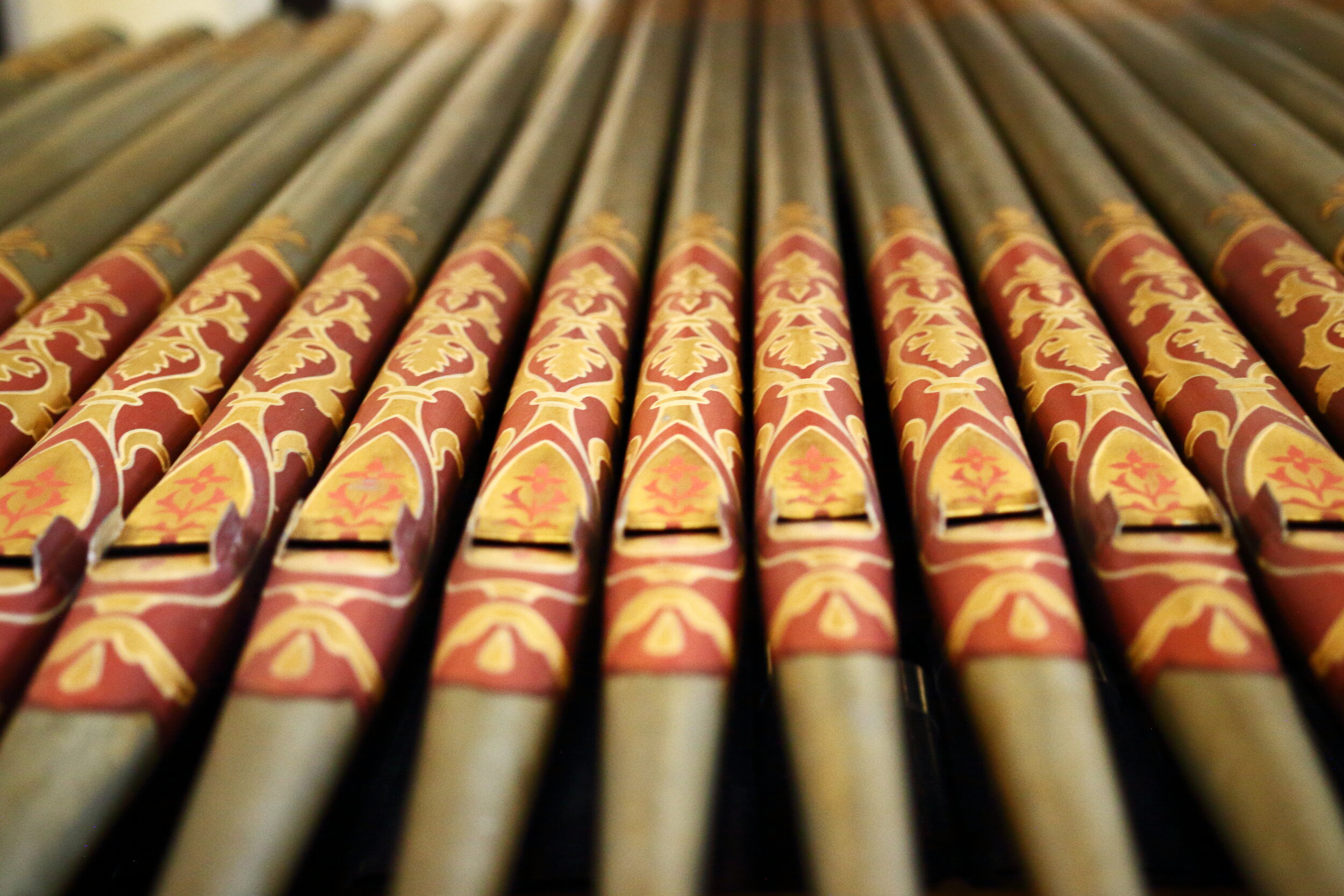
In 1998 the church organ was reported to need a complete overhaul. Apparently all the adjustable clips that tune the organ were missing, and masking tape had been stuck on pipes to tune them. Many of the pipes had been handled roughly and there was evidence of woodworm in the bottom of the organ. The cost to fix it was estimated to be £6500. There were concerns over the work of the organ tuner in the previous few years. He was no longer to be employed by the church.
Searches were made for an organ that would be suitable for the church. Two were found, but on measuring them they were too tall. Finally one was discovered in Stanley. It had been made by Bevington and Sons in 1870 for a large Victorian home. It was then passed on to a Baptist Church. In 1987 it was bought by a Mr Cunnisford, an engineer and craftsman, for £300. He erected a building in his garden to house it. To buy, dismantle and rebuild the organ, repair it and fit a modern pedal board was estimated to cost £5700. Unfortunately by 1999 the actual cost came to £8000, plus a very high electricity bill as the organ builders had put on all the heating for the weeks they were in the church. Amongst everything else they had to remove a squirrel’s nest from the middle of the organ. It was played for the first time in church on the 14th March 1999. It is still in full working order, being serviced annually. Unfortunately we have an organ but no organist.
From 1938 to 1988 Marjorie Coomber was our organist, and even after 50 years she continued to play periodically. Our last organist left us in 2010. We bought a CD player and CDs with hymns recorded upon them. A sound system with a loop facility to link in with hearing aids had been set up in the early 2000s. My memory is hazy here, but one Sunday we had a visiting service leader. Unfortunately the sound system picked up and broadcast the Elvis Presley Tribute act that was playing at the Hazlitt Theatre that evening and interrupted the service continually. I’m not sure how the service leader thought we had done it, but he never returned to us.
I give you these stories as evidence that our congregations consist of real people with complicated lives, who joined together as part of our Unitarian fellowship and maintained the building and the community as we still do today.